Millions of Stars in Cigar Galaxy
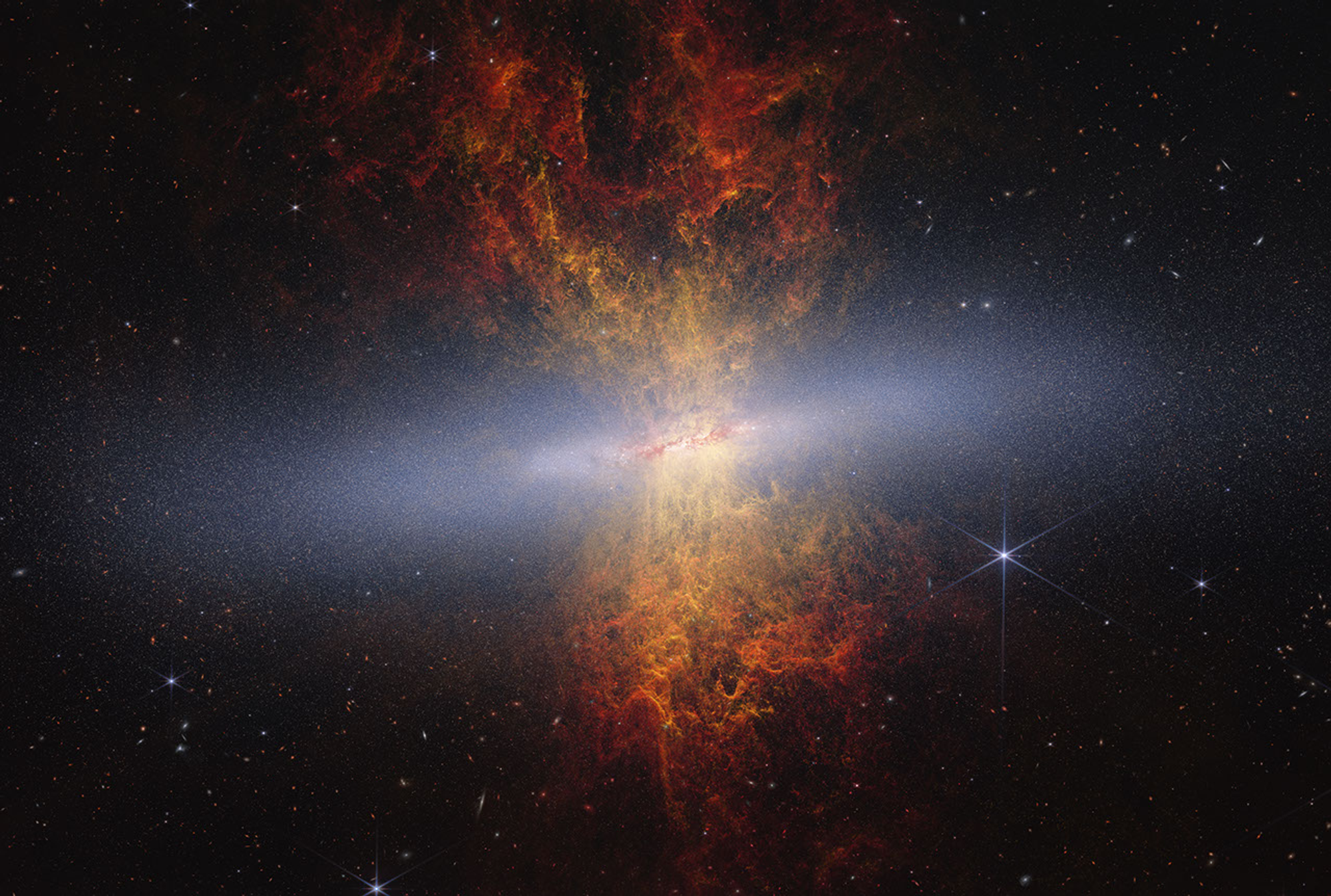
Scientists used NASA’s James Webb Space Telescope to image edge-on starburst galaxy Messier 82 and trace its evolutionary history. This Webb and Hubble composite image includes 16.5 million stars (blue-white), dust grains (red-orange), and ionized hydrogen gas (yellow). Image: NASA, ESA, CSA, Adam Smercina (STScI, Tufts), Thomas Williams (University of Manchester); Image Processing: Alyssa Pagan (STScI)
A team of astronomers recently completed an imaging survey with the Webb telescope. This program entailed a total of 65 hours of observation time with Webb’s NIRCam (Near-Infrared Camera) instrument and revealed never-seen-before details of the starburst galaxy, including its distended disk structure and millions of individual stars. Webb’s high-resolution imaging, specifically of the main plane of the galactic disk, has unlocked vital information for astronomers as they seek to uncover M82’s formation history. Additionally, the Webb data will help scientists understand the current processes occurring within the starburst galaxy.
“M82 is a mess, but it’s a beautiful mess. We don’t fully understand what’s going on, especially concerning its evolutionary history. What could have triggered such an elevated rate of star formation? How long has this galaxy been driving plumes of material away from its center?” said principal investigator Adam Smercina, a NASA Hubble Fellow at the Space Telescope Science Institute in Baltimore, and incoming Assistant Professor at Tufts University in Massachusetts. “M82 is an ideal galaxy evolution laboratory because it has properties that allow us to probe important physical processes, such as how stars form in such environments and how that activity drives outflows. M82 provides a simultaneous window onto many astrophysical questions, in a way that no other galaxy in the local universe can.”
Prior to Webb, many observatories looked at the starburst galaxy, including NASA’s Hubble and retired Spitzer space telescopes. However, the sheer volume of dust within that galaxy limited the amount of information astronomers could acquire on M82 at high resolution. While Webb has previously looked at this galaxy, the duration of the new imaging survey, combined with the telescope’s infrared sensitivity, enabled it to pierce through the thick dust.
(Source: NASA Science)