
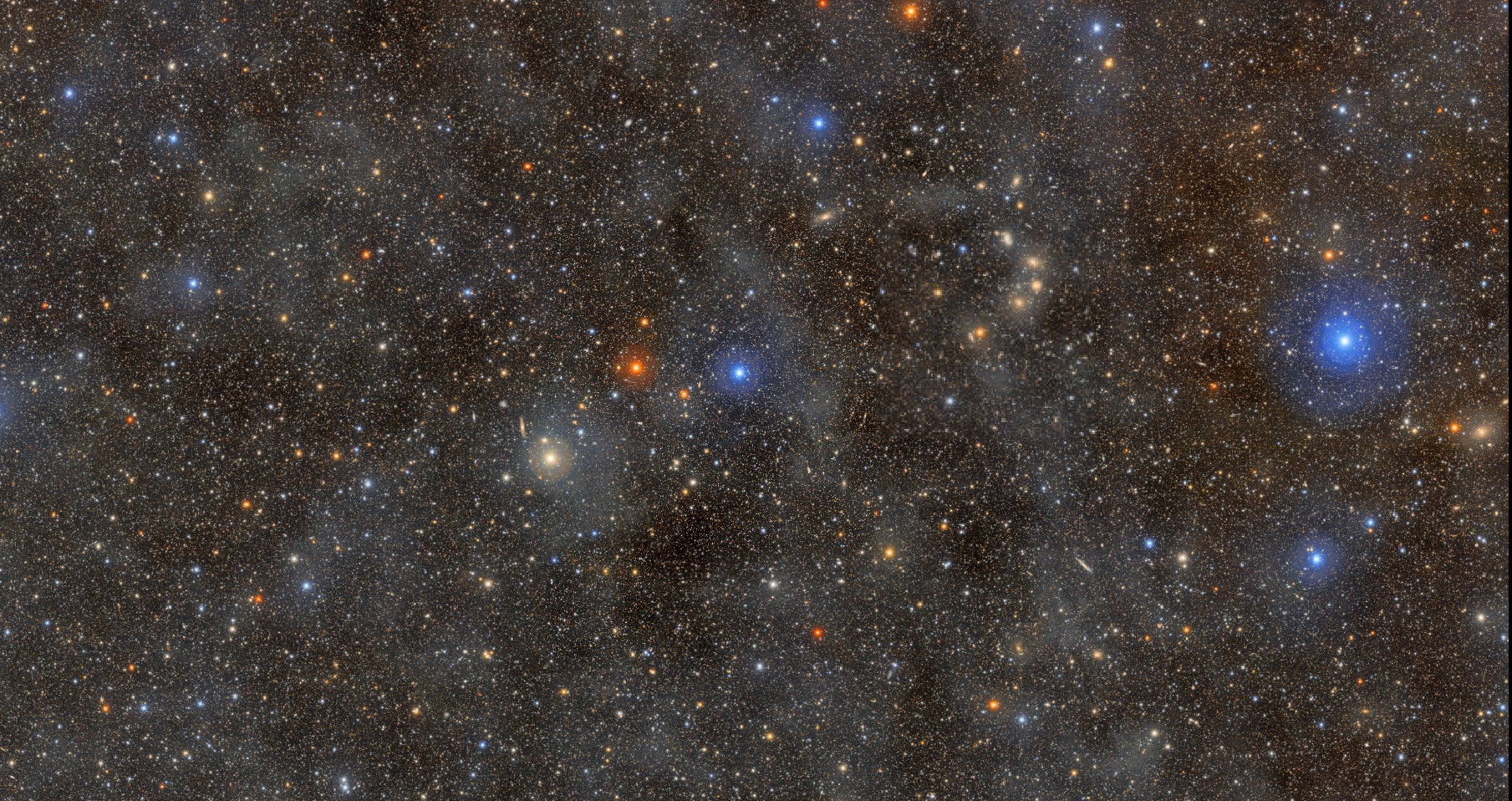
Vera C. Rubin Observatory Begins Its Legacy Survey of Space and Time
This 1.7-gigapixel view of the constellation Lupus was captured by the Vera C. Rubin Observatory. The image showcases the telescope’s unmatched range, resolving individual stars and faint dust within our own Milky Way, as well as countless distant background galaxies. Credit: NSF–DOE Vera C. Rubin Observatory/NOIRLab/SLAC/AURA
The NSF–DOE Vera C. Rubin Observatory has officially launched the Legacy Survey of Space and Time (LSST), a 10-year census of the southern sky that astronomers have anticipated for decades.
The announcement came June 30, capping a months-long commissioning process that followed the facility’s handover from construction to operations last October. “It is amazing and humbling to be here at this time and place as we start the Legacy Survey of Space and Time, after more than two decades of incredible work by our dedicated team,” said Bob Blum, director of Rubin Observatory at NSF NOIRLab, in a press release.
Perched atop Cerro Pachón in Chile, Rubin’s 8.4-meter Simonyi Survey Telescope is now sweeping the sky with the world’s largest camera — a 3,200-megapixel monster that produces a new image roughly every 40 seconds. Over the next decade, the observatory will revisit every corner of the southern sky about 800 times, collecting around 10 terabytes of data each night as well as generating up to 7 million automated alerts per night— flags for anything in the sky that has moved, brightened, dimmed, or otherwise changed.
(Source: astronomy.com)