
The Little Red Galaxies That May Be Sending Us Neutrinos
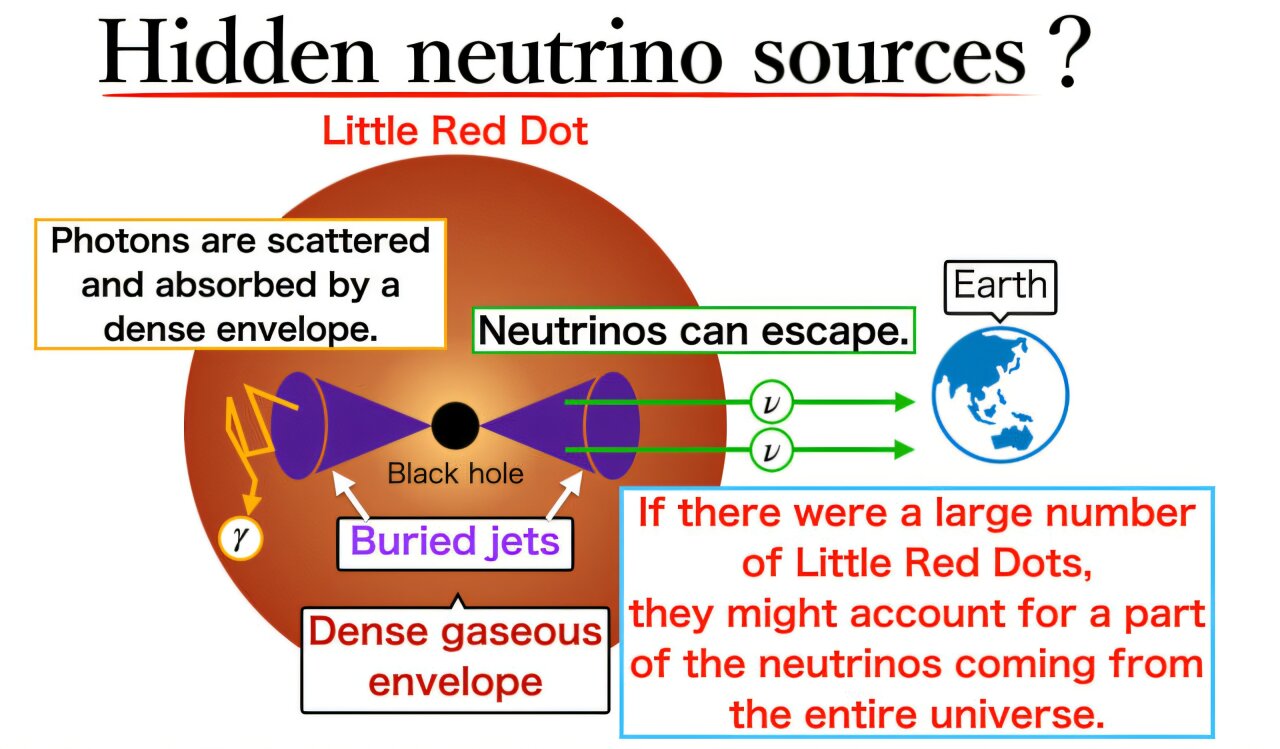
At the center of the Little Red Dot, there may be a black hole surrounded by a thick outer gaseous envelope. In this environment, photons produced near the center are absorbed and scattered by the gas, so neutrinos can escape the envelope without interacting with the surrounding gases. If there are many Little Red Dots, they may account for a part of the high-energy neutrinos arriving from the universe. Credit: KyotoU / Riku Kuze
Peering far into the distant, high-redshift universe, the James Webb telescope has discovered an abundance of small red galaxies known as the Little Red Dots. From their observations, astronomers believe that at least some of these galaxies may be home to growing supermassive black holes at their centers, objects which they believe are embedded in dense gaseous envelopes, an environment suitable for producing high-energy neutrinos.
Neutrinos are electrically neutral elementary particles with masses near zero. High-energy neutrinos from across the universe have been detected on Earth, but the origin of the all-sky high-energy neutrino background radiation has remained a mystery.
Neutrino production involves the collision of high-energy particles such as protons with surrounding photons or matter, and the resulting neutrinos can escape even if they are produced inside thick gas. Sources that produce high-energy neutrinos generally also produce gamma rays, yet if all sources that produced neutrinos also produced gamma rays, the result would exceed observed gamma-ray background levels.
Promising source candidates for these neutrinos must therefore be hidden objects from which gamma rays cannot easily escape. Certain features of the Little Red Dots prompted a team of researchers at Kyoto University to suspect they may be hidden neutrino sources. Since most Little Red Dots show little emission associated with jets or outflows, such as radio or X-ray emission, the researchers hypothesized a scenario in which the jets are buried within dense gas envelopes.
(Source: phys.org)