
A Million New SpaceX Satellites Will Destroy the Night Sky—For Everyone On Earth
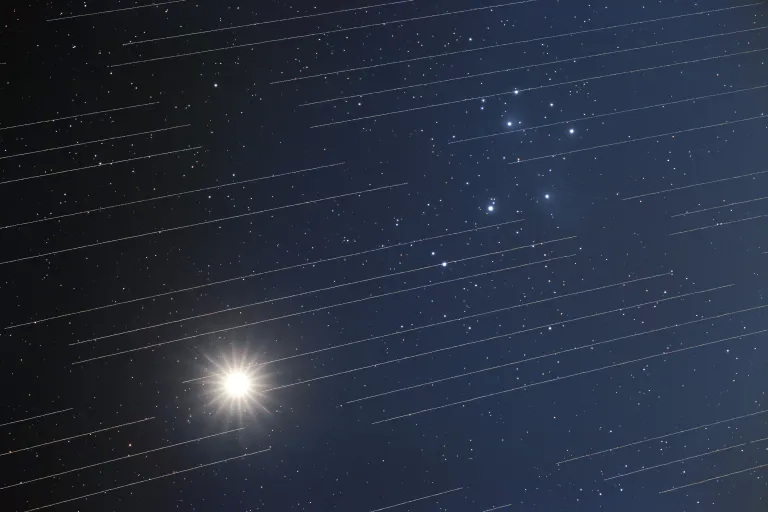
This image of Venus and the Pleiades shows the tracks of Starlink satellites. The reflective surfaces of the satellites, coupled with the fact that they are orbiting around Earth, mean that astronomical observations that require very long exposures capture “tracks” of the satellites in their images. Credit: T. Hansen/IAU OAE/Creative Commons Attribution
More than 10,000 Starlink satellites currently orbit Earth. We see them crawling across dark skies, no matter how remote our location, and streaking through images from research telescopes.
SpaceX recently announced that it wants to launch one million more of these satellites as orbital data centers for AI computing power.
A few years ago, the Astronomical Journal published a paper predicting what the night sky would look like with 65,000 satellites from four planned megaconstellations: SpaceX’s Starlink, Amazon’s Kuiper (now Leo), the U.K.’s OneWeb and China’s Guowang. The researchers calibrated their models to observations of real Starlink satellites and came up with a startling prediction: One in 15 visible points in the night sky would be a satellite, not a star.
A million satellites would be so much worse.
The human eye can see fewer than 4,500 stars in an unpolluted night sky. If we permit SpaceX to launch these satellites, we will see more satellites than stars—for large portions of the night and the year, throughout the world. This will severely damage the night sky for everyone on Earth.
SpaceX’s proposal also completely fails to account for atmospheric pollution, collision risk or how to develop the technology needed to disperse waste heat from orbital data centers.
(Source: phys.org)