
Second Saturday
Guest Speaker: Zoe Bozich
Clusters of stars are excellent laboratories for astronomers, looking to better understand stellar populations and evolution.
In person attendance limited to 30 people, sign up now!
Guest Speaker: Zoe Bozich
Clusters of stars are excellent laboratories for astronomers, looking to better understand stellar populations and evolution.
In person attendance limited to 30 people, sign up now!
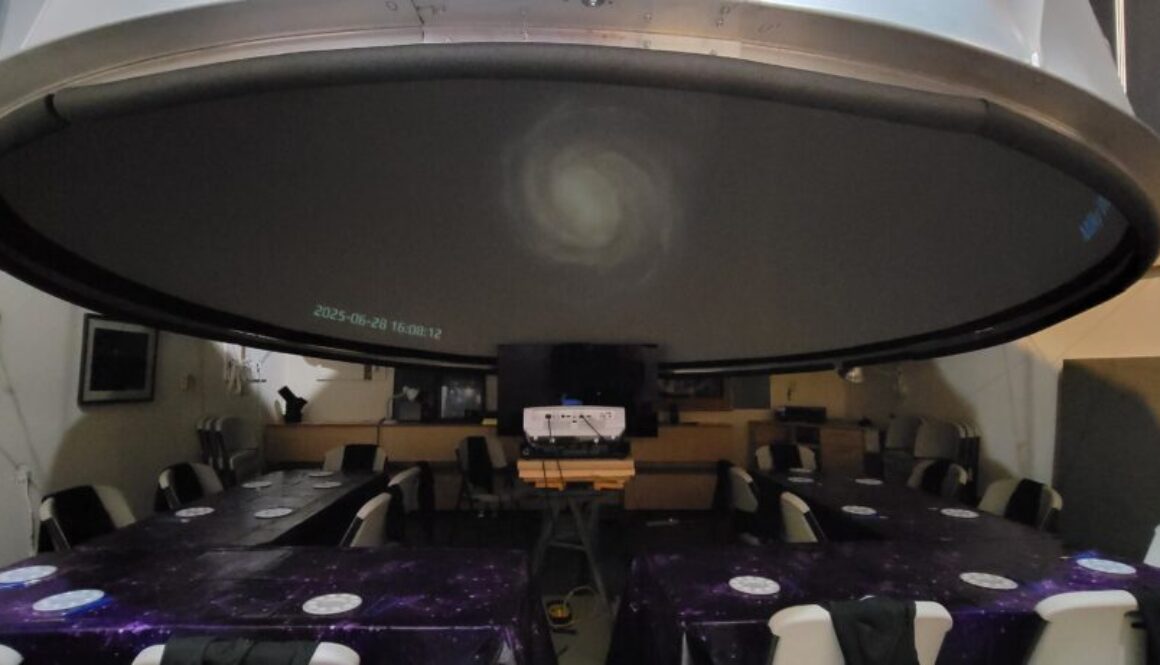
Join Battle Point Observatory’s artist in residence Deborah Milton on June 28th as she guides you and fifteen others through a beginner-friendly painting of the Milky Way.
There’s only a few tickets left, so hurry and get yours!
Or come and paint the Moon with us in Auugust!
Source for events and links are In-The-Sky.org, Dominic Ford, Editor. The links provide details for each event including a scale on how difficult they are to observe.
For the first time, evidence of cloud convection in Titan’s northern hemisphere was found, indicating significant methane weather patterns similar to Earth’s. The observations showed clouds rising to higher altitudes over a few days, suggesting active weather systems, particularly over regions with lakes and seas, which are vital for methane evaporation.
Betelgeuse, a red supergiant star located about 640 light years from Earth in the constellation Orion, is known for its unpredictable brightness and is nearing the end of its life, expected to explode as a supernova. A significant dimming event in late 2019 led to speculation about its imminent explosion, but it was later attributed to a dust cloud. Research suggests that Betelgeuse may have a low-mass companion star orbiting it every 2,100 days, which could explain its long-term brightness variations.
A recent study published in Astronomy & Astrophysics has discovered four new primordial open cluster groups in the Milky Way, revealing that these groups formed through sequential star formation processes from the same giant molecular cloud. Notably, two groups, G1 and G2, were formed following a hierarchical mechanism triggered by multiple supernova explosions, as indicated by distinct ring-like and arc-like morphologies. Researchers used high-precision data from the Gaia satellite to analyze these clusters, establishing a clear age-distance correlation that supports the triggered star formation framework.
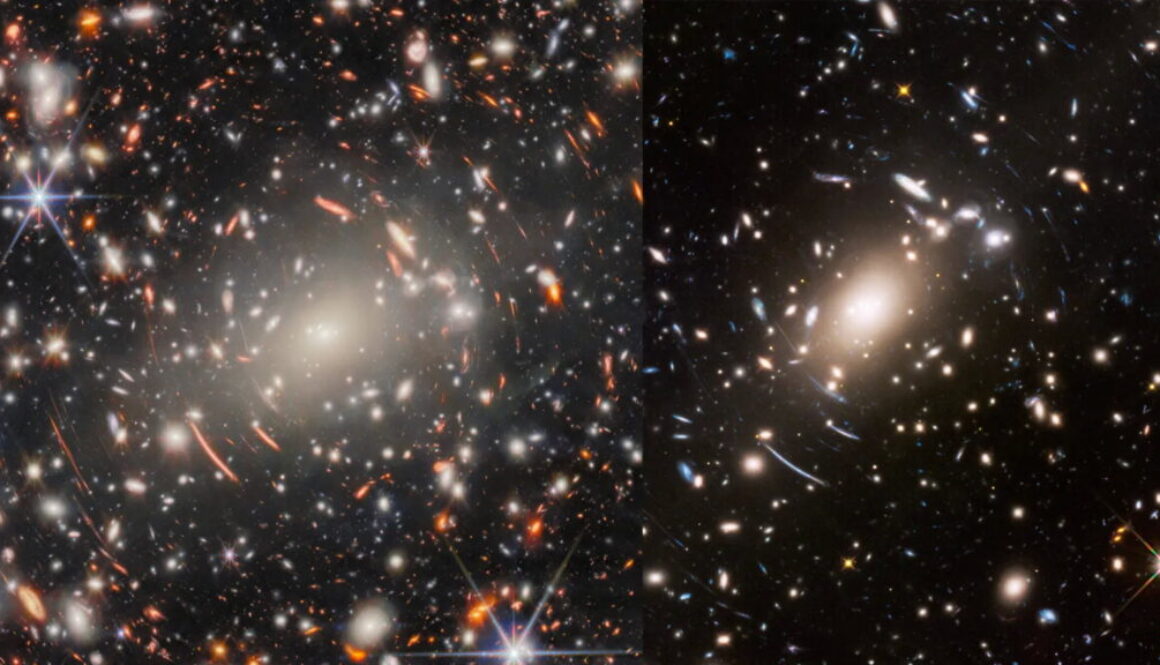
The James Webb Space Telescope (JWST) has confirmed the most distant bright galaxy known to date, MoM-z14, which existed in a universe just 280 million years old. This discovery challenges traditional galaxy formation theories and follows hints from the Hubble Space Telescope. The “Mirage or Miracle” survey is investigating whether these bright early galaxies are genuinely as distant as suspected, utilizing the Near-Infrared Spectrograph for further observations.
Satellite megaconstellations pose a significant threat to radio astronomy observations, according to a recent study. The proliferation of small satellites and commercial space initiatives could jeopardize the “radio quiet” necessary for astronomers to detect faint signals from celestial objects. Researchers, led by Mike Peel from Imperial College London, emphasize the need for a better understanding of satellite transmissions’ impact on radio telescopes to preserve access to dark and quiet skies for future astronomical research.
Although we barely feel it at all, planet Earth is moving relative to every other object in the Universe: through the Solar System, the galaxy, and the Universe at large.
BPAA is teaming with BI Parks to offer youth-oriented astronomy classes this summer. Go to our blog post through the link above for more information and registration links!