Blog
Women in STEM Book Club
The Women in STEM Book Club is two for two with great conversations and we’ve got another one for March!
Zoom Programming: What’s Up Next Month?
Special Zoom-only event on the last Thursday of every month!
Thursday, March 26th at 6:00 pm
March Planetarium Shows
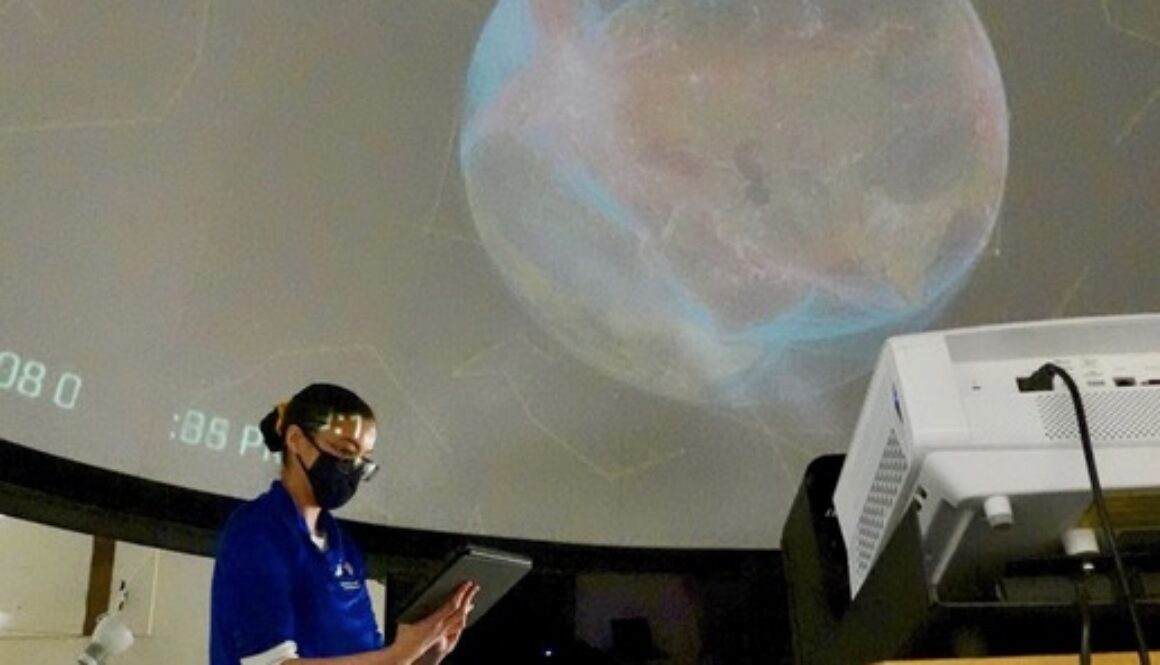
Our weekly planetarium shows continue this month on March 7, 14, & 28 at 12:30 and 2:30! Exact content is flexible based on audience interest, but common topics include constellations, planets, seasons, and astronomy history. Tickets are $10 for adults and $5 for children with a $5 discount for members.
Celebrate the Universe!
Join BPAA and Dark Sky Olympic Peninsula for a variety of local programs during April for International Dark Sky Week, April 13 – 20, 2026
Comet Neowise (c/2020 F3) Over Quilcene Bay
Credit: Alan Herold This spectacular image of Comet Neowise was taken by member Alan Herold at 11pm in July of 2020 from the eastern shore of Quilcene Bay. Nikon D80 DSLR, 45mm lens, f/5.6, 10 sec exp. This comet will not be back to our inner solar system for another 6800 years!
WHAT’S UP(COMING)! – Observation Calendar Mar-May 2026
Source for events and links below are In-The-Sky.org, Dominic Ford, Editor. The links provide details for each event including a scale on how difficult they are to observe. Additionally, here’s a link to a printable PDF for “Navigating the mid March Night Sky” from our friends at the Astronomical League! Mar 3 – Total lunar eclipse – Full Moon Mar 18 – New Moon Mar 20 – Conjunction of the Moon and Venus – March equinox Mar 21 – Asteroid 20 Massalia at opposition Mar 22 – Mercury at highest altitude in morning sky Mar 23 – Close approach of the Moon and M45 Mar 26 – Conjunction of the Moon and Jupiter Mar 27 – Close approach of the Moon and M44 Apr 1 – 136472 Makemake at opposition – Full Moon Apr 2 – The Sombrero Galaxy is well placed Apr 3 – Mercury at greatest elongation west Apr 5 – Messier 94 is well placed Apr 15 – The Whirlpool Galaxy is well placed Apr 17 – New Moon Apr 18 – Messier 3 is well placed Apr 15 – Close approach of the Moon and M45 Apr 22 – Conjunction of the […]
NASA’s Webb Examines Cranium Nebula
The differences in what Webb’s infrared instruments reveal and conceal within the PMR 1 “Exposed Cranium” nebula is apparent in this side-by-side view. More stars and background galaxies shine through NIRCam’s view, while cosmic dust glows more prominently in MIRI’s mid-infrared.
Astronomers Wake Up to 800,000 Notifications From Observatory Watching the Night Skies
The Vera C. Rubin Observatory spent the night staring at the dark cosmos, alerting astronomers of ongoing changes in the skies in real-time.
The observatory fired off its first wave of notifications from its new alert system on February 24, sending 800,000 alerts to astronomers’ computers around the world.
Record-Breaking Natural Laser Discovered 11 Billion Light-Years Away
Lasers aren’t only produced by humans here on Earth, but occur naturally in space as masers and, more powerfully, as megamasers.
While mapping out the neutral hydrogen in the Universe, the MeerKAT array serendipitously discovered the most distant megamaser ever in 2022, located 6.6 billion light-years away.
Now, that record has been broken again here in 2026, with a new gravitationally lensed megamaser shattering all prior records, yielding a discovery a whopping 11 billion light-years distant.