
Astronomers Find Strongest Evidence Yet That Betelgeuse Has a Companion
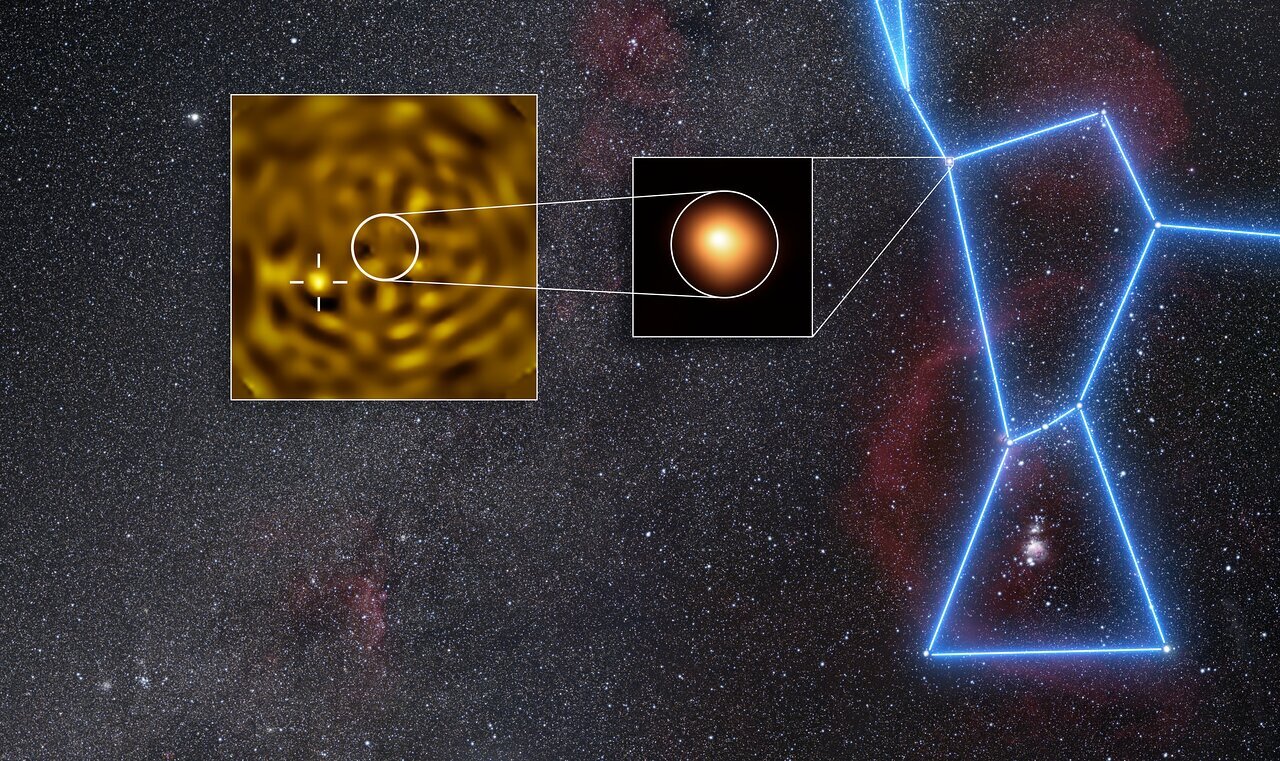
Using ESO’s Very Large Telescope (VLT), astronomers have obtained the clearest image ever of what likely is Betelgeuse B, a star orbiting Betelgeuse. Betelgeuse is a red supergiant star in the Orion constellation. Its brightness changes periodically, and for decades astronomers had suspected that some of these variations could be due to a companion star orbiting around it. The middle inset in the image above was taken in January 2019 with the SPHERE instrument at ESO’s VLT, and shows Betelgeuse itself. The image in the inset on the left was taken in December 2024, when the companion was predicted to be furthest apart from Betelgeuse as seen from Earth. In this inset Betelgeuse has been removed, revealing a source (marked with a crosshair) consistent with being Betelgeuse B. Credit: ESO/M. Montargès et al. Background: N. Rissinger (skysurvey.org)
At long last, astronomers have firm evidence that Betelgeuse, one of the most famous stars in the night sky, is not alone. Using the European Southern Observatory’s Very Large Telescope (ESO’s VLT), a team led by French researcher Miguel Montargès obtained the clearest image yet of what is likely Betelgeuse B, the star orbiting Betelgeuse. “This is the conclusion of a century-long quest,” Montargès says.
“We have shown that Betelgeuse is not single, it is accompanied by a faint stellar companion,” says Montargès, an astronomer at the Observatoire de Paris-PSL, France, and lead author of the study published in Astronomy & Astrophysics. Betelgeuse—a reddish star in the constellation Orion that is easily visible with the naked eye and is known to change in brightness—has been observed for millennia. But it still surprises astronomers.
“I jumped from my chair when I saw the processed images,” Montargès recalls. Astronomers have looked for the potential companion, originally proposed to explain Betelgeuse’s brightness changes, for about a century, but without success.
Two studies published in 2024 robustly predicted that in December that year, the companion would be farthest from Betelgeuse and therefore easier to spot. Montargès and his team got to work, observing the star with ESO’s VLT in December 2024 and spending several months processing the data.
“Honestly, I thought we did not have the sensitivity to detect Betelgeuse B as it was predicted,” Montargès explains. “Because it is more massive than predicted, we see it!” Originally thought to be about as massive as the sun, the new observations reveal that Betelgeuse B has around two to three times the mass of the sun.
“The fact that we can still discover a nearby companion, more massive and brighter than the sun, around such a well-studied star is remarkable,” Montargès says. “These are among the best moments in science: seeing something new, unexpected.”
(Source: phys.org)