
Origins Of Uranus and Neptune Are Surprisingly Different
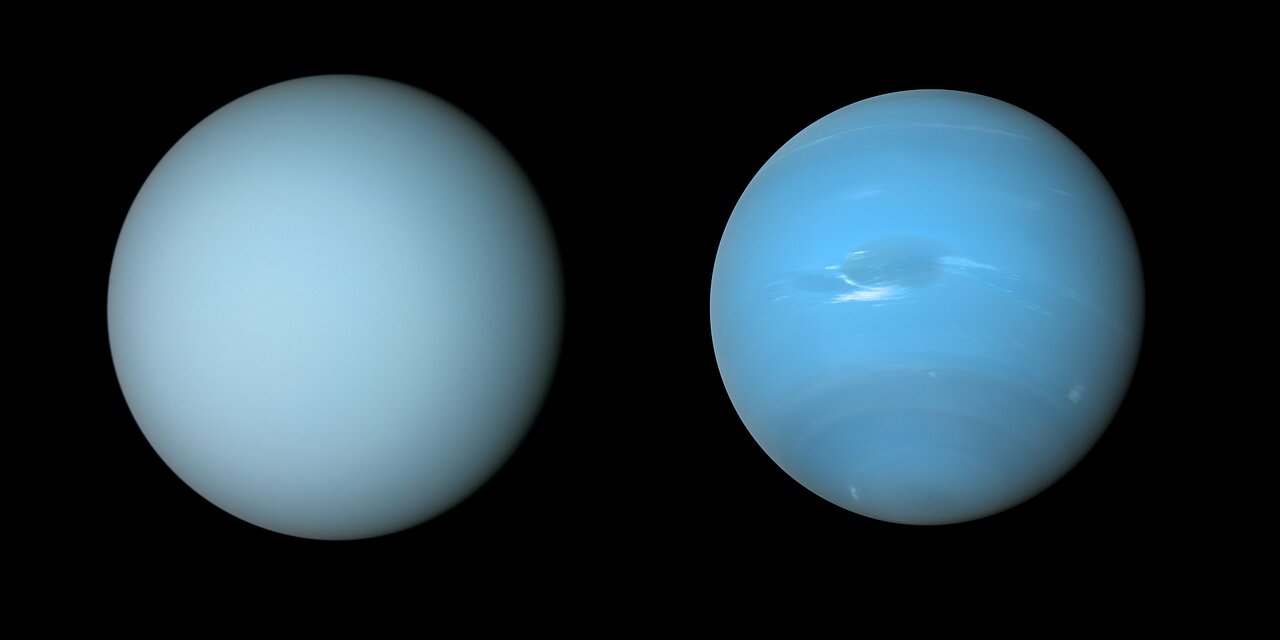
NASA’s Voyager 2 spacecraft captured these views of Uranus and Neptune in the late 1980s. A new study suggests that the origins of Uranus and Neptune are significantly different, despite their similarities. Image via NASA/ JPL-Caltech/ B. Jónsson/ NOIRLab.
Uranus and Neptune appear to be much alike, and in some ways they are. But a new study from an international team of scientists says that the origins of Uranus and Neptune are quite different.
The researchers said on October 19, 2026, that Neptune’s material building blocks originated much closer to the sun than those of Uranus. So although the two planets are superficially similar, their evolutionary paths are quite different.
The researchers published their peer-reviewed results in Astronomy & Astrophysics on October 19, 2026.
Uranus and Neptune have long been regarded as “twins.” They’re similar in size, both blue or greenish-blue, with deep atmospheres of methane, ammonia and water. There are no solid surfaces beneath their atmospheres. Co-author Olivier Mousis, a program director in the Southwest Research Institute’s (SwRI’s) Solar System Science and Exploration Division in Boulder, Colorado, said: “Uranus and Neptune may resemble twins today, but their chemistry is telling us that they are more like cousins with very different histories. Their atmospheric compositions may be connected to different regions of the protoplanetary disk where the planets formed, which would make their similarities a noteworthy coincidence.”
(Source: earthsky.org)