
NASA’s Webb Redefines Dividing Line Between Planets, Stars
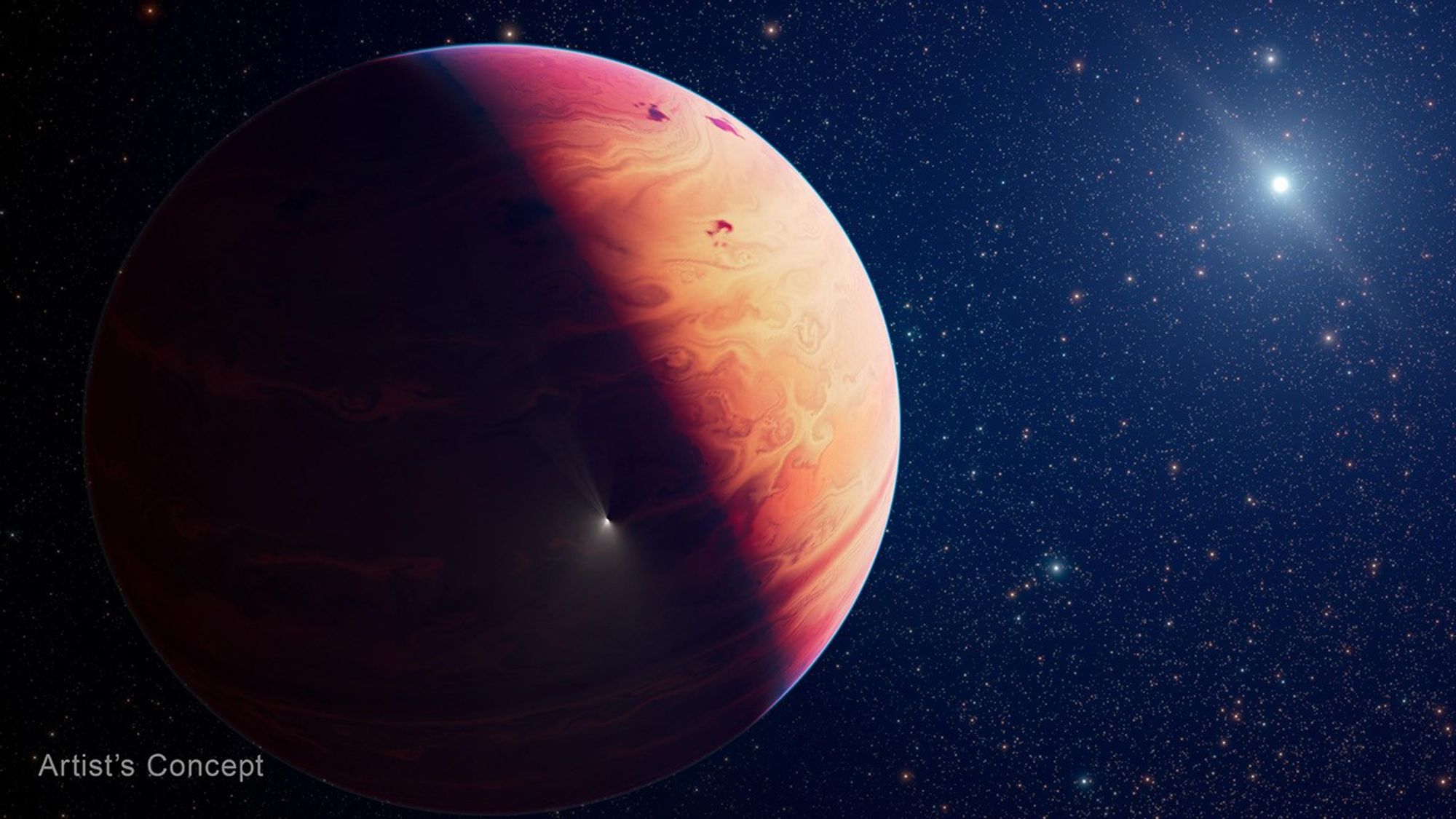
Exoplanet 29 Cygni b, seen in this artist’s concept, is a gas giant weighing about 15 times the mass of Jupiter. Astronomers studied 29 Cygni b with NASA’s James Webb Space Telescope. They determined that it likely formed from accretion rather than disk fragmentation. Illustration: NASA, ESA, CSA, Joseph Olmsted (STScI)
Planets, like those in our solar system, form in a bottom-up process where small bits of rock and ice clump together and grow larger over time. But the heftier the planet, the harder it is to explain its formation that way.
Astronomers used NASA’s James Webb Space Telescope to examine 29 Cygni b, an object about 15 times as massive as Jupiter orbiting a nearby star. They found multiple lines of evidence that 29 Cygni b indeed formed from this bottom-up process, bringing new insights into how the heftiest planets come to be. A paper describing these findings published Tuesday in The Astrophysical Journal Letters.
The planet formation process is broadly understood to occur within gigantic disks of gas and dust around stars through a process called accretion. Dust gloms together into pebbles, which collide and grow larger and larger, forming protoplanets and eventually planets. The largest then collect gas to become giants like Jupiter. Since it takes more time for gas giants to form, and the disk of planet-forming material eventually evaporates and disappears, planetary systems end up with many more small planets than large planets.
In contrast, stars form when a vast cloud of gas fragments and each piece collapses under its own gravity, growing smaller and denser. A similar fragmentation process could theoretically occur within protoplanetary disks as well. That could explain why some very massive objects are found billions of miles from their host stars, in regions where the protoplanetary disk should have been too tenuous for accretion to occur.
(Source: science.nasa.gov)