
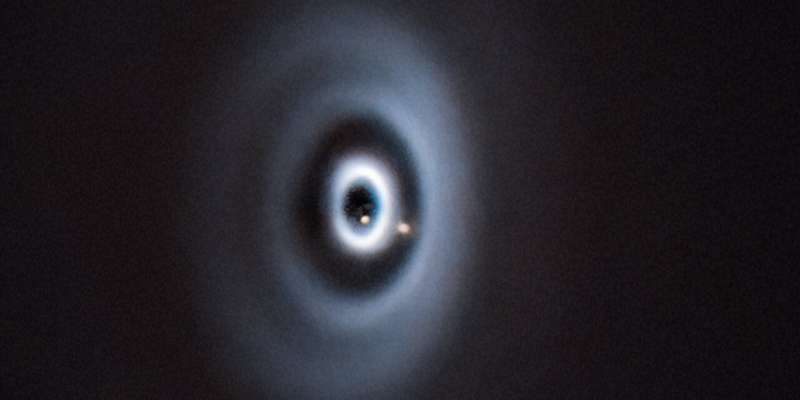
Earth Formed from Material Exclusively from the Inner Solar System
This is roughly what the formation of the Earth in our solar system might have looked like. The birth of two planets (light brown dots) in a protoplanetary disc around the young star WISPIT 2. Credit: ESO / C. Lawlor, R. F. van Capelleveen et al. / Creative Commons BY 4.0
Planetary scientists have long debated where the material that formed Earth comes from. Despite its location in the inner solar system, they consider it likely that 6–40% of this material must have come from the outer solar system, i.e., beyond Jupiter. For a long time, material from the outer solar system was considered necessary to bring volatile components such as water to Earth. Accordingly, there must also have been an exchange of material between the outer and inner solar systems during the formation of Earth. But is that really true?
Planetary scientists Paolo Sossi and Dan Bower, from ETH Zurich, compared existing data on the isotopic ratios of a wide range of meteorites, including those from Mars and the asteroid Vesta, with those of Earth. Isotopes are sibling atoms of the same element (same number of protons) that have a different mass (different number of neutrons).
The researchers analyzed this data in a new way and arrived at a surprising conclusion: the material that makes up Earth originates entirely from the inner region of the solar system.
Material from the outer solar system, by contrast, is likely to account for less than two percent of Earth’s mass, or even nothing at all. The corresponding study has been published in the journal Nature Astronomy.
“Our calculations make it clear: the building material of Earth originates from a single material reservoir,” says Sossi. His colleague Bower adds, “We were truly astonished to find that Earth is composed entirely of material from the inner solar system distinct from any combination of existing meteorites.”
(Source: phys.org)