A Cosmic First: Separated Sibling Stars Reunited by Supernovae
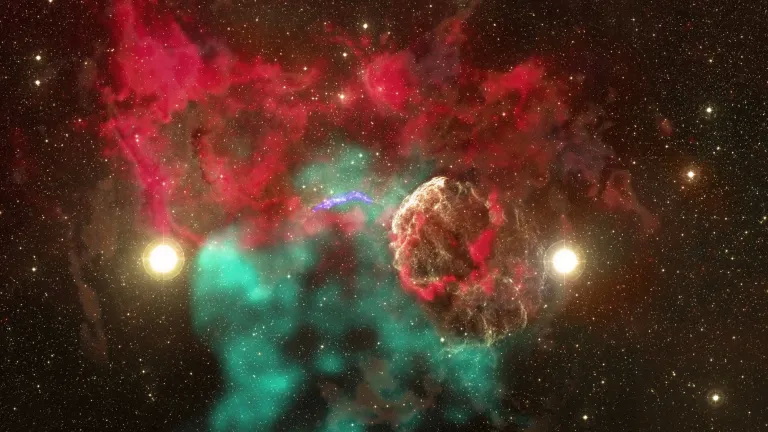
This multiwavelength view of the region around the IC 443 complex (the Jellyfish Nebula) reveals many extended features in gamma-ray and other energetic wavelengths of light. Although the bright bubble at the right is the most prominent feature, there is evidence, particularly from the gamma-ray data, that suggests an overlapping, earlier supernova remnant in almost the same region of sky. If confirmed, this would mark the first detection of two supernovae originating from the same progenitor system. Credit: NASA Goddard Space Flight Center and M. Michailidis et al. 2026; orange, brown: radio, ESA/Planck and MWISP; yellow: optical, DSS; red: infrared, NASA/WISE; violet: ultraviolet, NASA/Swift; teal: X-rays, SRG/eROSITA
Stars aren’t typically born in isolation, but rather in large groups of hundreds or even thousands, with approximately half of those stars winding up bound together in multi-star (like binary) systems.
For the highest-mass stars, binaries are the norm rather than the exception, and those stars are often comparable in mass, rather than mismatched. As a result, they’re both typically short-lived: destined to die in supernova explosions.
For the very first time, a new supernova remnant has been traced back to an older supernova remnant in the same complex within the Milky Way: the first “supernova reunion” of separated sibling stars ever.
(Source: Big Think)