Will the Hubble “Constant” Ever Become an Actual Constant?
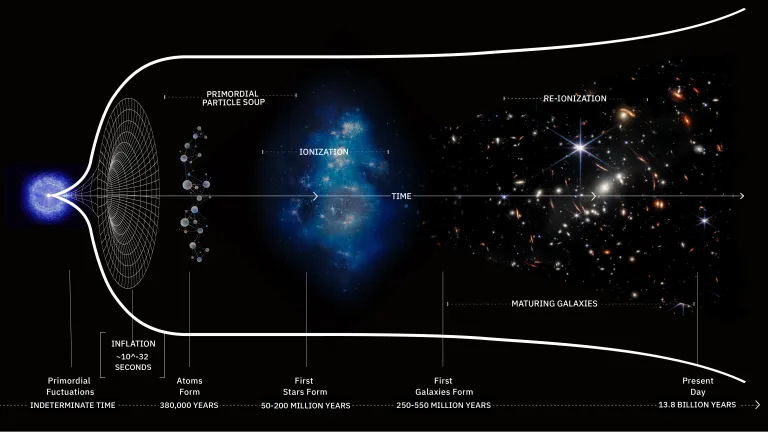
At the start of the hot Big Bang, the Universe was rapidly expanding and filled with high-energy, very densely packed, ultra-relativistic quanta. An early stage of radiation domination gave way to several later stages where radiation was sub-dominant, but never went away completely, while matter then clumped into gas clouds, stars, star clusters, galaxies, and even richer structures over time, all while the Universe continues expanding. The expansion rate evolves dependent on the sum total of all the forms of energy present within it, linking the observed expansion to the energy contents of our cosmos. Credit: Big Think / Ben Gibson / NASA / Pablo Carlos Budassi
Ever since the Universe’s expansion was discovered, we established a relationship between how far away an object is and how fast it appears to be receding from us: a straight-line fit known as Hubble’s (or the Hubble-Lemaître) Law.
The slope of that line has been called the “Hubble constant” since the relationship was first discovered nearly 100 years ago, but we’ve learned that it not only evolves over time, but isn’t even constant across all of space.
Nevertheless, because of how the Hubble parameter evolves, it may someday become a constant: both in time and in space. Whether that happens or not depends entirely on the still-mysterious nature of dark energy.
Follow the link below for a more in-depth discussion of the topic.
(Source: Big Think)