
Astronomy

NASA’s Webb Traces Details of Complex Planetary Nebula
NASA’s James Webb Space Telescope has captured detailed images of the planetary nebula NGC 6072, revealing a complex and asymmetrical structure formed by multiple outflows of gas from a dying star. These observations provide insight into the late stages of stellar evolution and the interactions shaping the nebula’s unique appearance.

Baby Planet Clears Gap in Young Protoplanetary Disk
An international team of astronomers has directly imaged a newborn planet, WISPIT 2b, orbiting within a gap it cleared in the multi-ringed protoplanetary disk of the 5-million-year-old star TYC 5709-354-1, located 430 light-years away. This marks the first clear detection of an embedded planet in such a cleared gap, with observations revealing its orbital motion and hydrogen gas accretion, confirming it as a rare example of a growing protoplanet.

Astronomers Discover One of the Most Massive Binary Stars in the Galaxy
Using archival Hubble Space Telescope data and new observations, astronomers have precisely measured the binary star system NGC3603-A1 in the starburst region NGC 3603, located 22,000 light years from the Sun. This system consists of two massive stars weighing approximately 93 and 70 times the mass of the Sun, orbiting each other every 3.8 days, making it one of the most massive and fastest-orbiting binary systems discovered in our galaxy.
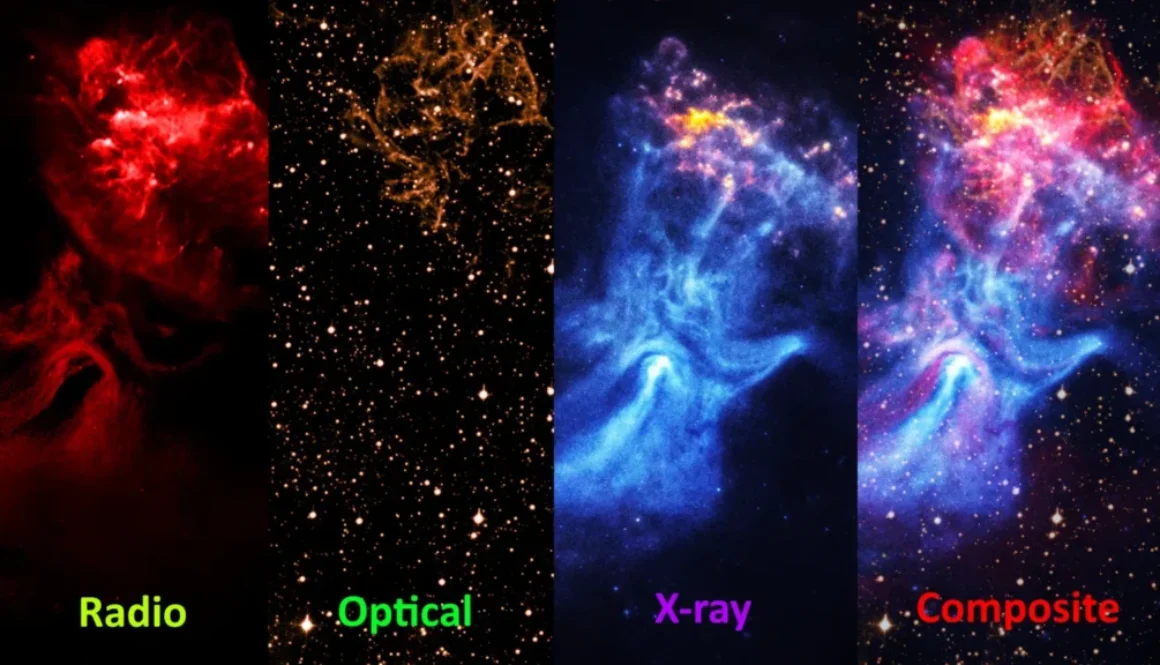
How A Dead Star Carved The “Hand of God” In Space
Located 17,000 light-years away, a very special nebula, carved by a young, pulsing, rapidly spinning neutron star, looks like an enormous cosmic hand, reaching out through the void.
But this isn’t a cosmic hand at all: it’s a region of interstellar space filled with cosmic particles, heated and energized by the surrounding environment, with a special role played by the young pulsar.

TESS Spotted 3I/ATLAS Two Months Before It Was Discovered
The Transiting Exoplanet Survey Satellite (TESS), primarily designed to observe stars and detect exoplanets, captured images of the interstellar object 3I/ATLAS as early as May, two months before its official discovery in July. This early detection, along with previous findings from the Vera Rubin Observatory, indicates that 3I/ATLAS may have been active during that time.

Dark Energy-Filled Black Holes Plus DESI Data Give Neutrino Masses That Make Sense
Recent data from the Dark Energy Spectroscopic Instrument (DESI) at Kitt Peak National Observatory reveal that dark energy’s effect on the universe may be evolving over time, suggesting matter could be transforming into dark energy. These findings also provide new insights into neutrino masses, aligning theoretical frameworks with observed cosmic phenomena.

The Fall BI Parks and Rec Catalog Is Out — And We’re In It!
We’re teaming up with Parks and Rec once again for a fresh lineup of out-of-this-world classes! Planet Pioneers (ages 8–12) and Galaxy Guild (ages 13–17) are back with all-new content, and we’re excited to introduce a trial run of our brand-new adult series: Introduction to Astronomy 101 (ages 16+). You asked for adult classes, and we heard you. We hope you’ll join us for this exciting new venture!

Second Saturday Science Talk, August 9th at 7 pm – Measuring the Night Sky
August’s Science Topic – Measuring the Night Sky
09 Aug 2025 19:00 – 21:00
Speaker: Erin Leigh Howard, Rubin scientist (and our very own Planetarium Manager!)
Would You Be Interested In A Women In Stem-Focused Book Club?
We’re thinking about starting a Zoom book club this Fall or Winter focused on biographies and memoirs about Women in STEM–and we’d love to know if you’d be interested in joining!