No Cosmic Conversations in October
Instead, BI Parks Haunted Hayride experience takes over Battle Point Park for three nights of Halloween magic, October 21-23!
No Cosmic Conversations in October
Instead, BI Parks Haunted Hayride experience takes over Battle Point Park for three nights of Halloween magic, October 21-23!
Professor Brian Cox will be appearing at the Moore Theatre in January 2027. Tickets just went on presale with code COSMOS.
Please save the date for the Battle Point Astronomical Association Annual Meeting!
Saturday, January 10th, 2026 at 6 pm
The NSF–DOE Vera C. Rubin Observatory, starting in late 2025, will begin the Legacy Survey of Space and Time (LSST)—the most expansive sky survey ever conducted. Using a 3,200-megapixel camera built at SLAC National Accelerator Laboratory, it will capture an 8GB image every 40 seconds, revisiting the same sky regions every three nights. This decade-long project aims to uncover rare cosmic events by collecting vast amounts of astrophysical data. The observatory is jointly funded and operated by the NSF and DOE.
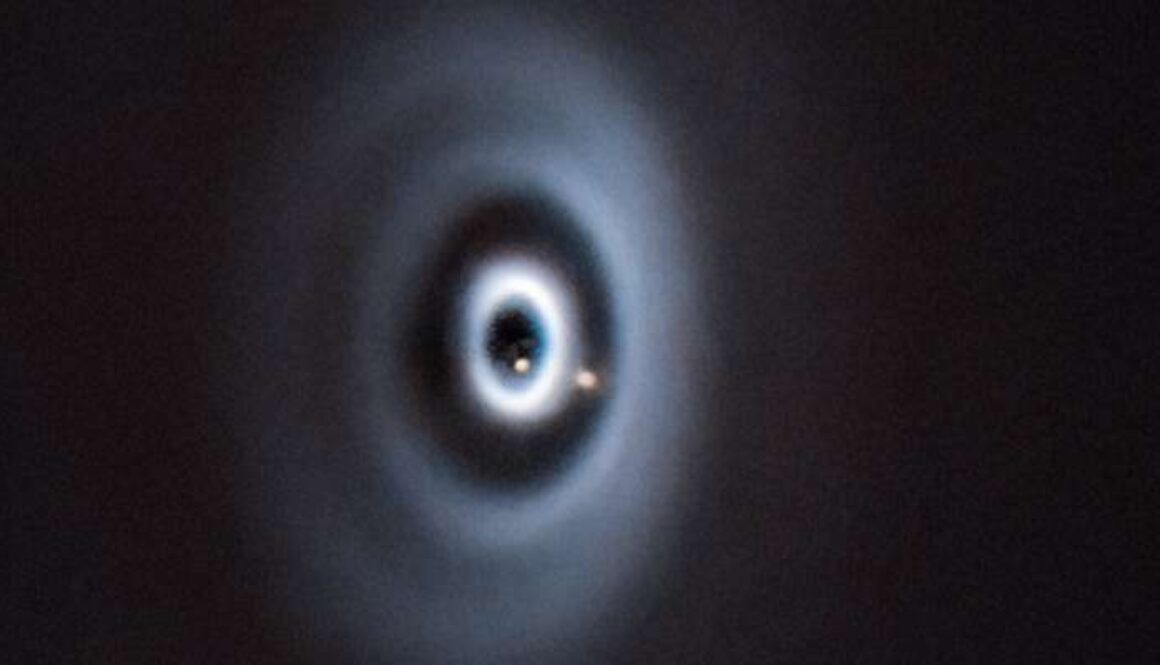
Scientists using the James Webb Space Telescope have discovered a peculiar owl-faced structure formed by the rare collision of two ring galaxies. This cosmic event, located billions of light-years away, offers a unique opportunity to study galaxy evolution. Ring galaxies like Hoag’s Object emerge when a smaller galaxy passes through a larger one, creating shock waves that push stars and gas into a ring around a central core.
NASA’s James Webb Space Telescope captured a rare and massive stellar jet erupting from a growing protostar in the Sharpless 2-284 nebula. The jet spans 8 light-years—twice the distance to Alpha Centauri—and resembles a double-bladed lightsaber. The protostar, about ten times the mass of our Sun, lies 15,000 light-years away. Scientists were surprised by the discovery, as such powerful outflows of molecular hydrogen from massive stars are uncommon in our galaxy.
A mysterious brown dwarf nicknamed “The Accident” is helping scientists uncover why silicon is rarely detected in the atmospheres of gas giants like Jupiter, Saturn, and similar exoplanets. Discovered in 2020 by a citizen scientist through NASA’s Backyard Worlds project, The Accident has an unusual mix of traits seen in both young and old brown dwarfs. Its unique features allowed it to evade standard detection methods. Recent observations using the James Webb Space Telescope have provided new insights, with findings published in Nature on September 4.
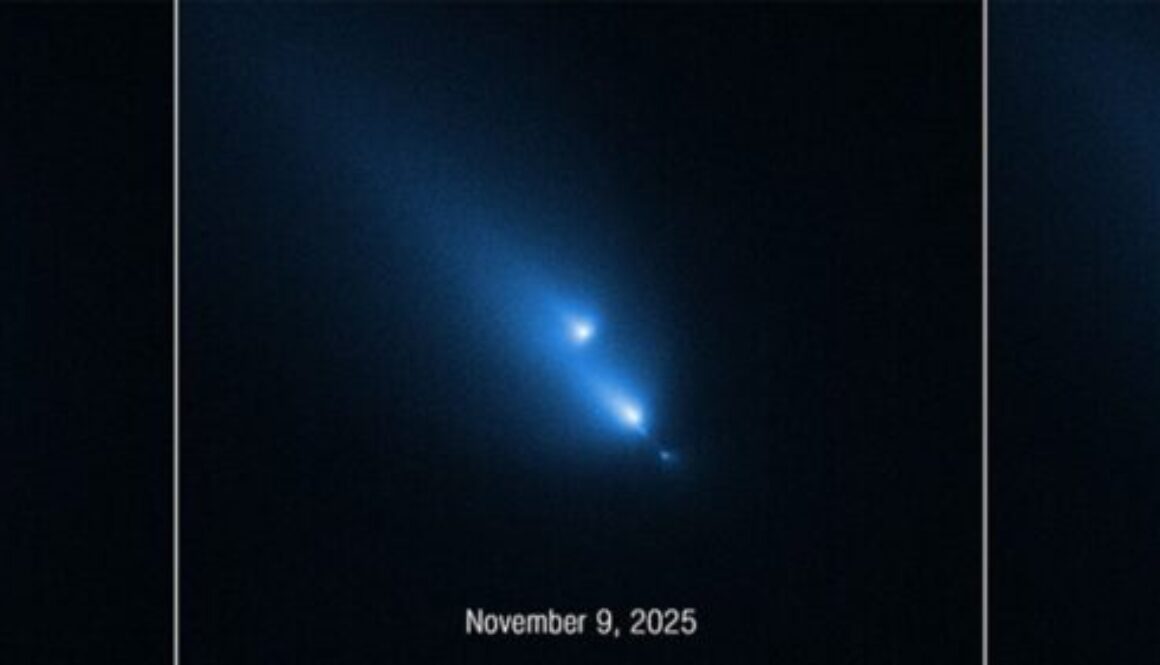
The interstellar comet 3I/ATLAS, the third-known object from deep space to enter our solar system, will not approach Earth closely but will pass within 30 million kilometers of Mars on October 3rd. This proximity offers a rare opportunity for observation using cameras and spectrometers aboard Mars orbiters like Mars Express and ExoMars. Scientists hope to capture images of the comet’s coma, though resolution limitations and signal strength may restrict results to monochromatic visuals. Spectral data would be a bonus, but no guarantees are being made.
A team of scientists has observed an extraordinary gamma ray explosion outside our galaxy that lasted much longer than usual. Typically, gamma ray bursts are brief, but this one persisted for an entire day, making it a rare and puzzling event. Detected in July and reported in September, the phenomenon was studied using both ground-based and space telescopes, including Hubble. Researchers are still investigating its origin, and more data is needed to pinpoint its exact location. The findings were published in the Astrophysical Journal Letters by a European-led team.