The Science Case for Why Pluto Still Isn’t a Planet
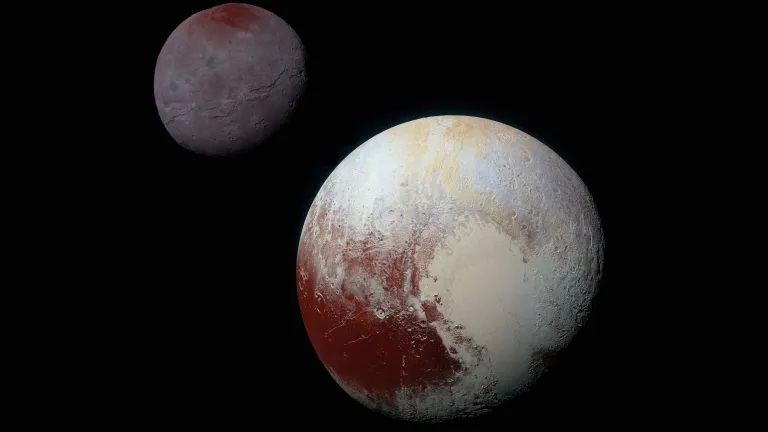
This composite image of Pluto and its largest moon, Charon, was based on photographs taken by the New Horizons mission as it flew by the Plutonian planetary system back in 2015. Charon’s appearance is vastly different from Pluto’s, but both bodies are shown with the correct relative size and albedo. Credit: NASA, APL, SwRI
From 1929 until 2006, Pluto lived in the imagination of children and adults alike as the ninth and outermost planet in our solar system. Until 1978, with the discovery of its giant moon, Charon, it was the only known large object in our solar system that orbited beyond the reach of Neptune. But the story began to change shortly after that. In the 1990s and 2000s, a tremendous number of new objects were discovered — including planets orbiting stars other than our Sun (exoplanets) and a wide variety of Kuiper belt objects (trans-Neptunian objects) both large and small — that compelled us to rethink just what it meant for an object to be considered a planet.
In 2006, with only a small fraction of the general assembly in attendance, the International Astronomical Union put forth three criteria that an object needed to meet in order to be officially defined as a planet:
-
It must be massive enough to pull itself into hydrostatic equilibrium, where gravitation and rotation determine its overall shape.
-
It must orbit the Sun and the Sun alone, eliminating any satellite worlds such as moons.
-
It must “clear its orbit,” meaning that, over solar system-like timescales, there are no other comparably-massed objects that share its orbit.
Rather than adding in additional planets such as Ceres and Eris, or accommodating the newfound population of exoplanets, this move instead changed the number of planets in the solar system by one: from 9 to 8. The big change affected Pluto most severely: stripping it of its longstanding planetary status.
This definition remains controversial even today, both among scientists within specific subfields of astronomy and planetary science, as well as politically, as many note that this is only making news today to serve as a distraction from the ongoing catastrophic funding cuts to NASA and NSF science.
However, alternative definitions that draw a dividing line with Pluto on the “it is a planet” side are all scientifically indefensible unless one focuses purely on intrinsic properties alone, ignoring planetary formation, composition, and history. Here’s the reasoning behind Pluto’s changing status.
(Source: Big Think)