The Most Distant Lensing Cluster Reveals a Dark Matter Surprise
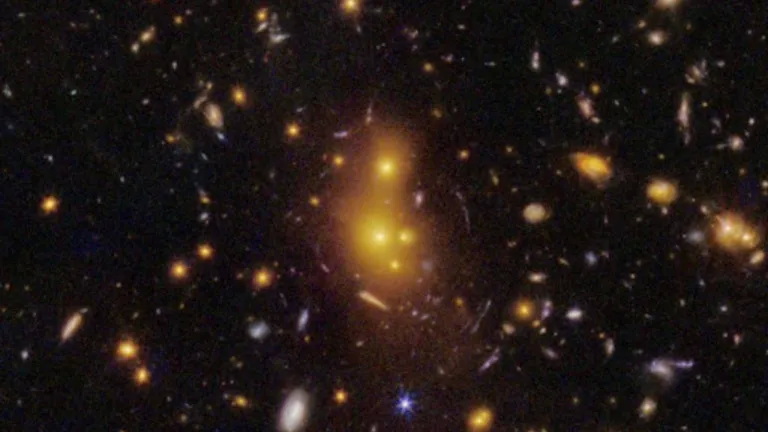
The wide-field image above is a multiwavelength composite from JWST data, focused on the center of massive early galaxy cluster XLSSC 122. With a mass of 300 trillion Suns at a time corresponding to just 3.3 billion years after the Big Bang, it is the most distant galaxy cluster to act as a strong gravitational lens ever discovered. Credit: NASA, ESA, CSA; Kyle Finner (Caltech/IPAC) Processing: Robert Hurt (Caltech/IPAC-SELab)
Over 10 billion years in the past, an ultra-massive galaxy cluster lenses objects behind it. That has big implications for dark matter.
In theory, it should take somewhere around 3 billion years before the first mature, grown-up massive galaxy clusters appear after the Big Bang, with cluster XLSSC 122 being the most massive early cluster found so far.
Although it was imaged previously with Hubble, the new JWST imagery is much more spectacular, revealing fainter features at higher resolution, including a series of blue arcs that indicate strong gravitational lensing: the most distant lensing cluster ever found.
That strong lensing allows us to measure how concentrated the dark matter is toward the center, and unlike nearby galaxy clusters, the dark matter is far more concentrated. Click the source link below to find out more about what’s going on, and how.
(Source: Big Think)