
NSF–DOE Vera C. Rubin Observatory Reveals Its First Dwarf Planet Candidate in Our Solar System
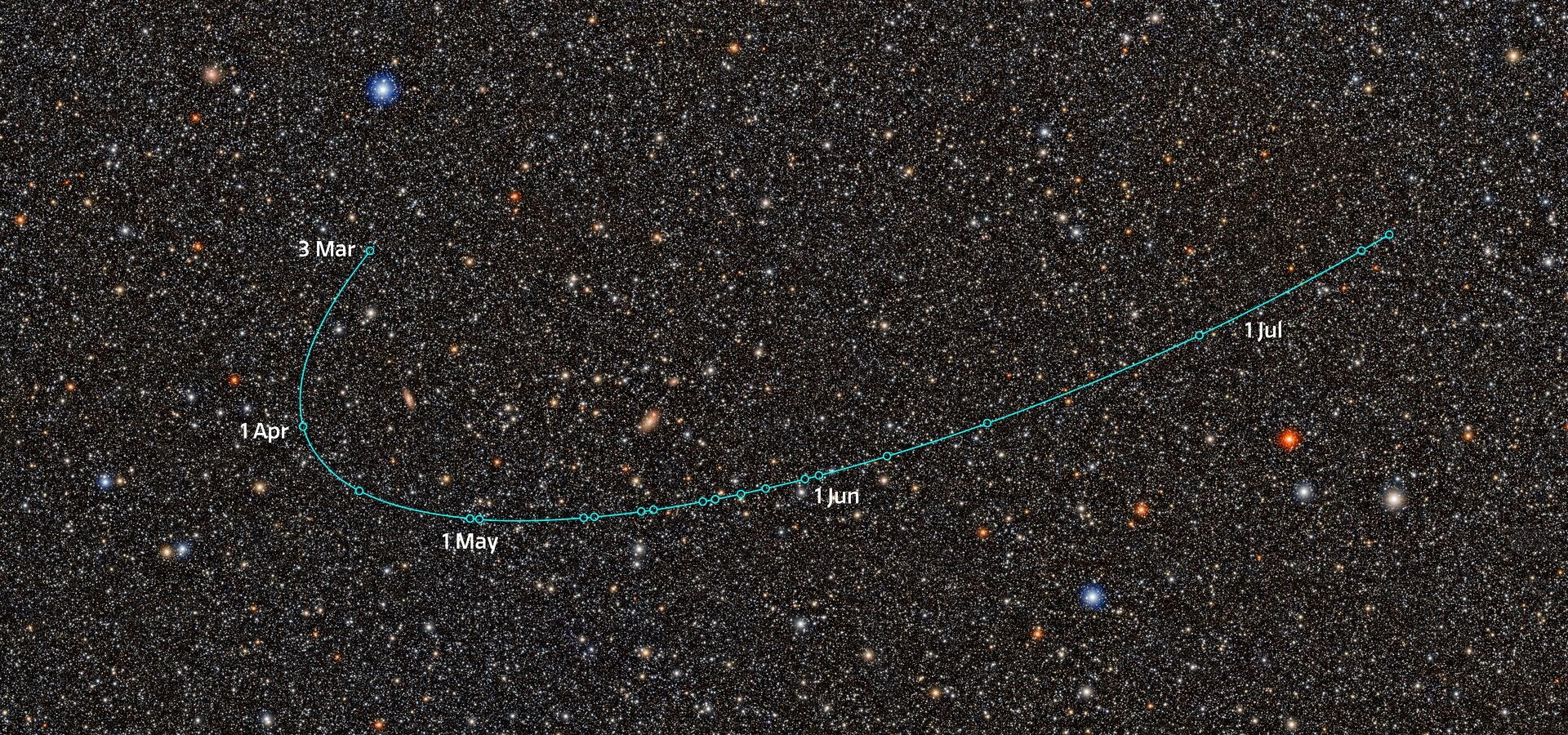
This image shows the orbital pathway of newly discovered dwarf planet candidate 2026 ED138 (ED138), as observed by NSF–DOE Vera C. Rubin Observatory. This image is a composite of multiple images captured by Rubin between 4 March and 11 July 2026 at intervals indicated by the teal circles. ED138 is visible at the center of each circle. Credit: NSF–DOE Vera C. Rubin Observatory/NOIRLab/SLAC/AURA Acknowledgement: Image Processing: M. Jurić (UW), D. de Martin & M. Zamani (NSF NOIRLab)
In the outer reaches of our Solar System, beyond the orbit of Pluto, NSF–DOE Vera C. Rubin Observatory has spotted 2026 ED138 — a large, bright trans-Neptunian object that scientists have identified as a dwarf planet candidate. The observations were announced today by the International Astronomical Union Minor Planet Center (MPC). If confirmed, ED138 would be among the largest dwarf planets ever discovered in this region of the Solar System.
With observations taken during the run up to the Legacy Survey of Space and Time (LSST), NSF–DOE Vera C. Rubin Observatory has discovered a new dwarf planet candidate in our Solar System. The candidate, which has been given the provisional designation 2026 ED138 (ED138), was found by Rubin Operations team member and in-Kind contributor Matthew Holman (Center for Astrophysics | Harvard & Smithsonian [CfA]). He contributes to improving Rubin’s algorithms that search for distant moving objects in our Solar System. The candidate’s distance from the Sun places it beyond the orbit of dwarf planet Pluto. Initial analysis indicates that it may be among the largest and brightest bodies scientists have discovered in this region of the Solar System.
Rubin Observatory is jointly funded by the U.S. National Science Foundation and the U.S. Department of Energy’s Office of Science.
“Rubin Observatory’s super power is the ability to clearly capture movement and change among a vast number of objects and phenomena that humans have never seen before,” says Edward Ajhar, NSF Program Director for Rubin Observatory. “That power greatly extends our ability to reveal and understand new things about our Solar System, the Milky Way, and billions of other galaxies across the Universe.”
(Source: rubinobservatory.org)