NASA’s Hubble Charts Path for Roman with Gravitational Lenses
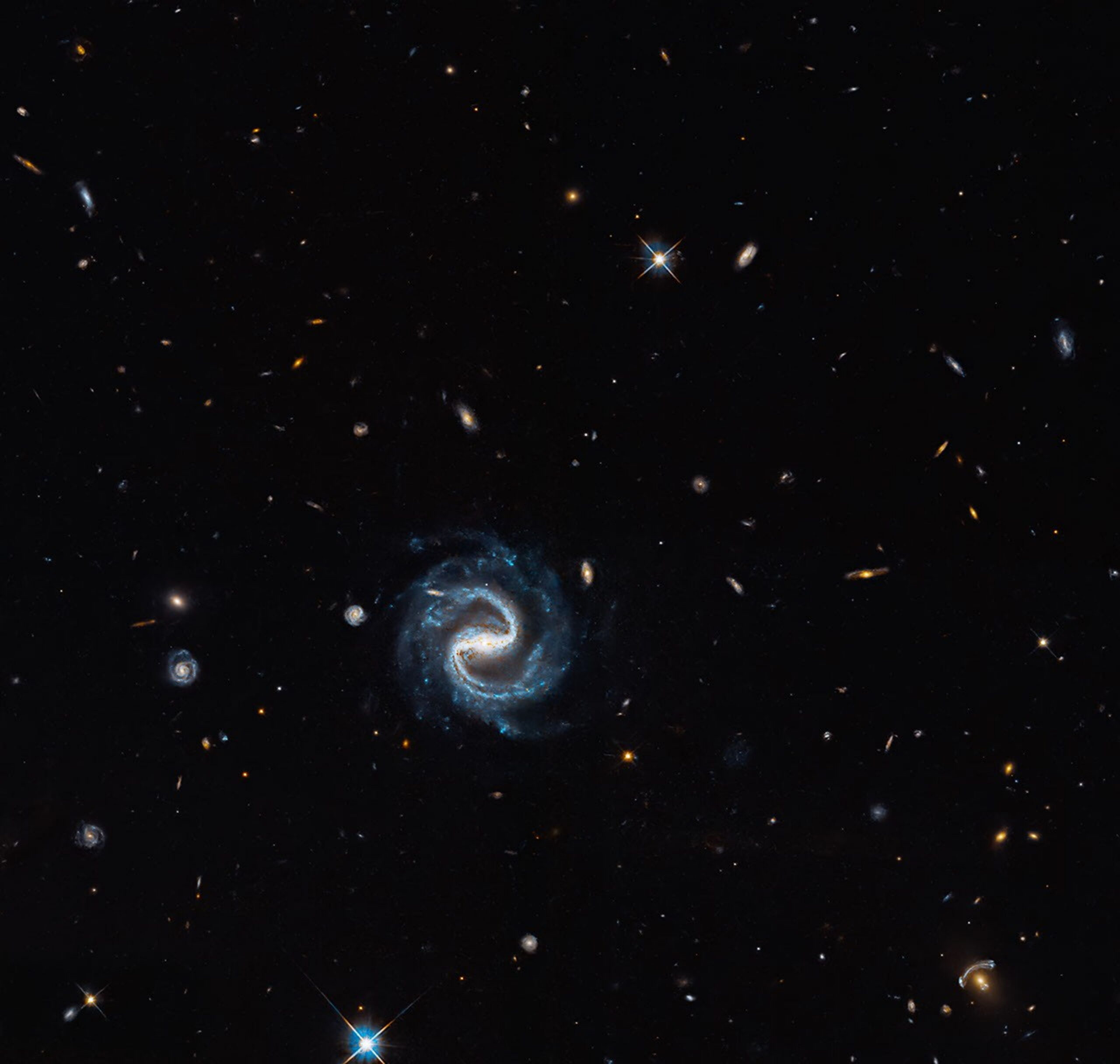
A sinuous spiral galaxy (center) appears in the same field of view as a vivid gravitational lens (right corner) in this Hubble image. The lens consists of a reddish elliptical foreground galaxy and the blue arcs of a magnified background galaxy. Credit: NASA, ESA, and X. Huang (University of San Francisco); Processing: Gladys Kober (NASA/Catholic University of America)
A sweeping barred spiral galaxy marks the spot in this image, but the real treasure is the gravitational lens in the lower-right corner, where a distant background galaxy is being magnified and distorted by the gravity of a closer galaxy.
This observation is one of many gravitational lensing images taken by NASA’s Hubble Space Telescope in preparation for science with the new Nancy Grace Roman Space Telescope.
Gravitational lensing occurs when the mass of a foreground object – such as a galaxy – warps spacetime, causing light to bend, distort, and magnify as it passes around the object, similar to a giant lens in space. Lenses like this occur when a precise chance alignment takes place between the foreground and background galaxies, causing light from the background galaxy to curve around the foreground galaxy.
Images like this offer a glimpse of how Hubble and Roman will work together to build an even more comprehensive picture of the cosmos. This is just one of many gravitational lens images captured by Hubble. Astronomers will use them to analyze gravitational distortions to learn more about dark matter in the foreground galaxies and to lay the groundwork for future Roman observations.
(Source: NASA Science)