
NASA’s Webb Discovers Hidden Planet in Famous Star System
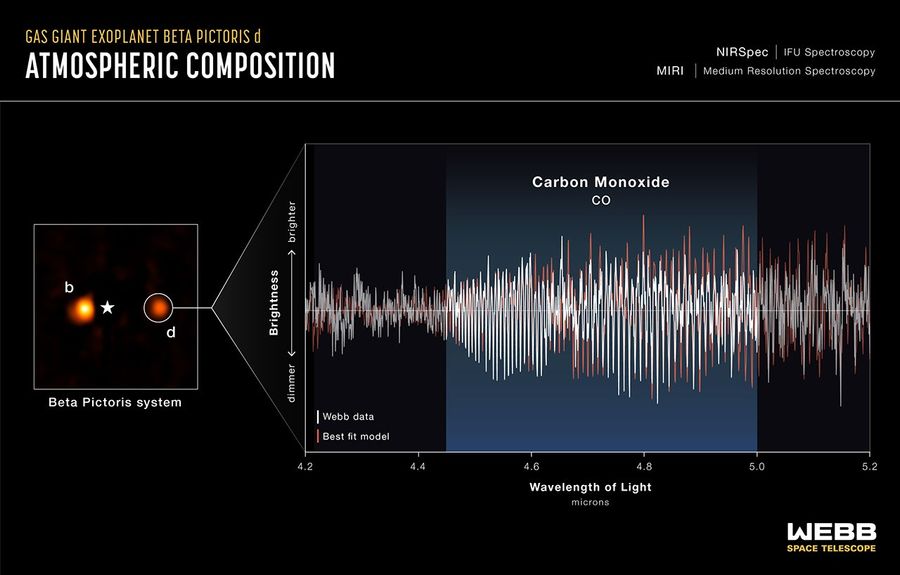
Researchers used the NIRSpec (Near-Infrared Spectrograph) Integral Field Unit on NASA’s James Webb Space Telescope to map chemical contents of the Beta Pictoris system. As a result, they discovered a third planet, Beta Pictoris d, orbiting the young star. Image: NASA, ESA, CSA, STScI, Leah Hustak (STScI); Science: Aidan Gibbs (UC San Diego), Jean-Baptiste Ruffio (UC San Diego), Alexis Bidot (STScI); Image Processing: Alyssa Pagan (STScI)
Astronomers using NASA’s James Webb Space Telescope have discovered a giant planet outside our solar system, called an exoplanet, hiding within one of the most intensely studied planetary systems in our Milky Way galaxy.
The young, nearby star Beta Pictoris was already known to host two giant planets: Beta Pictoris b, one of the first exoplanets ever directly imaged, and Beta Pictoris c. The newly identified Beta Pictoris d makes it only the second planetary system known to contain at least three imaged planets. Unlike Beta Pictoris b and c, however, Beta Pictoris d was discovered not by identifying a bright point of light, but by detecting the unique chemical fingerprint of its atmosphere, a technique that could transform the search for worlds around other stars.
“This discovery adds another piece to an already fascinating planetary system,” said Aidan Gibbs, lead author of a new study published Wednesday in the Astrophysical Journal Letters and a postdoctoral researcher at the University of California, San Diego. “Beta Pictoris has long served as a laboratory for understanding how planetary systems form and evolve, and now we have another planet helping us tell that story.”
(Source: science.nasa.gov)