
White Dwarf Discovered Gobbling Material from Gamma Cassiopeia
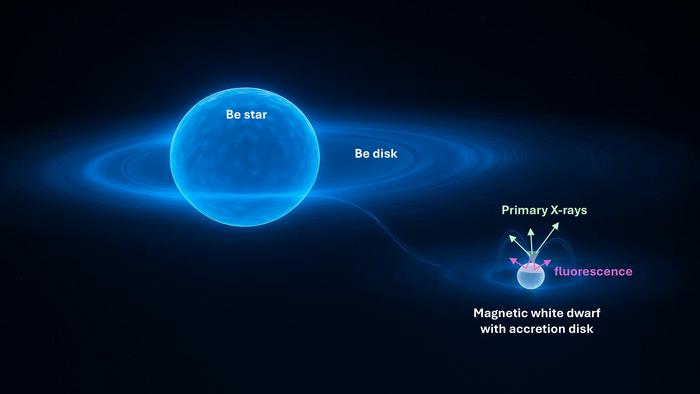
Gamma Cas consists of a Be-type star surrounded by a disk of material; some of this material flows toward the companion; a second disk forms around the companion, and the material eventually flows toward the poles, where it emits X-rays (green arrows). Some of these X-rays are reflected by the surface of the white dwarf (purple arrows). Credit: University of Liège / Y.Nazé
Some 550 light-years away, a bright star called Gamma Cassiopeiae is belching out bursts of X-rays. Now, astronomers have discovered that the radiation is actually coming from the star’s invisible companion, which lights up in X-rays as it gobbles up material from the star.
Gamma Cassiopeiae (Gamma Cas for short) is visible to the naked eye at 2nd magnitude, making up the center of the Cassiopeia constellation’s distinctive “W” in northern skies. It’s a variable star that’s exhausting its supply of hydrogen, but it hasn’t run out just yet. Unlike other stars like it, it emits X-rays.
The star is surrounded by a gaseous disk, and for years, astronomers theorized that the emission was being produced either from the star’s magnetic fields interacting with the disk, or perhaps from disk material falling onto an unseen companion star.
Now, in a study published in Astronomy & Astrophysics, a team led by Yaël Nazé (University of Liège, Belgium) has observed the system with the X-Ray Imaging and Spectroscopy Mission (XRISM) space telescope. The researchers conclude that the white dwarf companion is the one emitting the X-rays as it consumes material from Gamma Cas. These revelations help astronomers learn more about how these exotic massive stars evolve and interact with each other.
(Source: Sky & Telescope)