Less Of the Night Sky Is Visible Than Ever Before
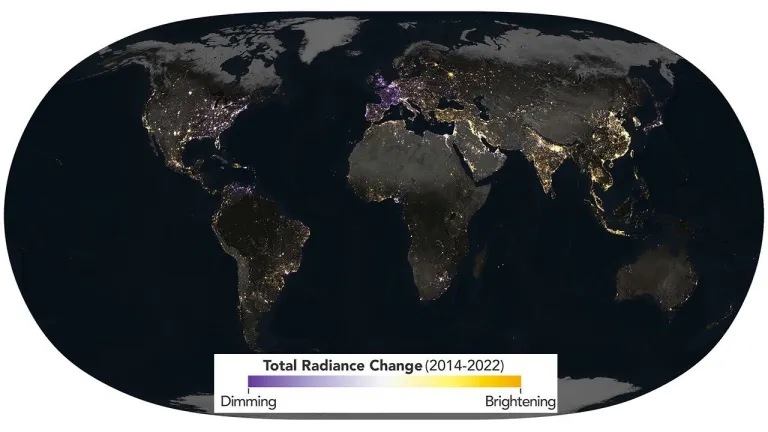
This planet-wide analysis, using data from NASA’s Black Marble, shows which portions of the planets have brightened (in gold) and dimmed (in blue) over the time period from 2014-2022. While a few notable areas in northwest Europe and in central/south America have dimmed, the overall radiance change has been a 34% increase in artificial lighting at night over this nearly 9-year time period. Credit: NASA Earth Observatory/Michala Garrison
Light pollution now steals a pristine night sky from the majority of humanity. The rise of LED lighting, primarily since 2014, is to blame.
Back in the 19th century, the night sky from all locations on Earth was pretty much as it had been since prehistoric times: pristine, free from both artificial light pollution and human-made satellites.
Beginning with the rise of electrification, light pollution has severely dimmed our view of the heavens, particularly with the rise of LED lighting, while artificial satellites often outshine the sky’s natural wonders.
In a new study of the artificial light at night, changes from 2014-2022 across the globe were tracked, showing just how much of the sky humans have been losing. The problem is worse than nearly anyone realizes.
(Source: Big Think)